Report from the Flaherty
It’s our first big chunk of downtime at the Flaherty Seminar.We’ve seen some great work so far and started some interesting discussions.
Two discoveries for me are the work of Tan Pin Pin, who makes very authored films “exploring Singapore’s histories, contexts, and limits,” and that of Lillan Schwartz, a lovely woman in her 80s who was a pioneer in computer-generated art.
Pin Pin’s “Invisible City” moves between several subjects who are all passionate about uncovering and preserving aspects of Singapore before its modern present.Through the humor and tragedy, and the emerging details of the pre-colonial, polyglot past, we are left most of all with a deepened understanding of the human drive to memorialize.
Quebecois filmmaker Caroline Martel presented a work-in-progress of “Wavemakers,” a piece which also assembles a vast amount of detail in service of a higher filmmaking vision.In this case, it is the colorful history and technique of the Onde Martenot, one of the first electronic musical instruments.I really appreciated Caroline’s humane search for the “vital impulse” that inspires these engineers, composers, and musicians to find a way to translate sound into music.
Having been put into a dreamy space by Caroline’s film and a live Onde Martenot performance by one of the film’s subjects (Suzanne Binet-Audet), we were truly ready to receive Lillian Schwartz’s beautiful computer-generated films from around 1970.We watched some of them with ChromaDepth 3D glasses, which Lillian recently discovered have the effect of heightening the depth perception she was aiming to create in the films (having suffered from an eye condition which limited her own depth perception).
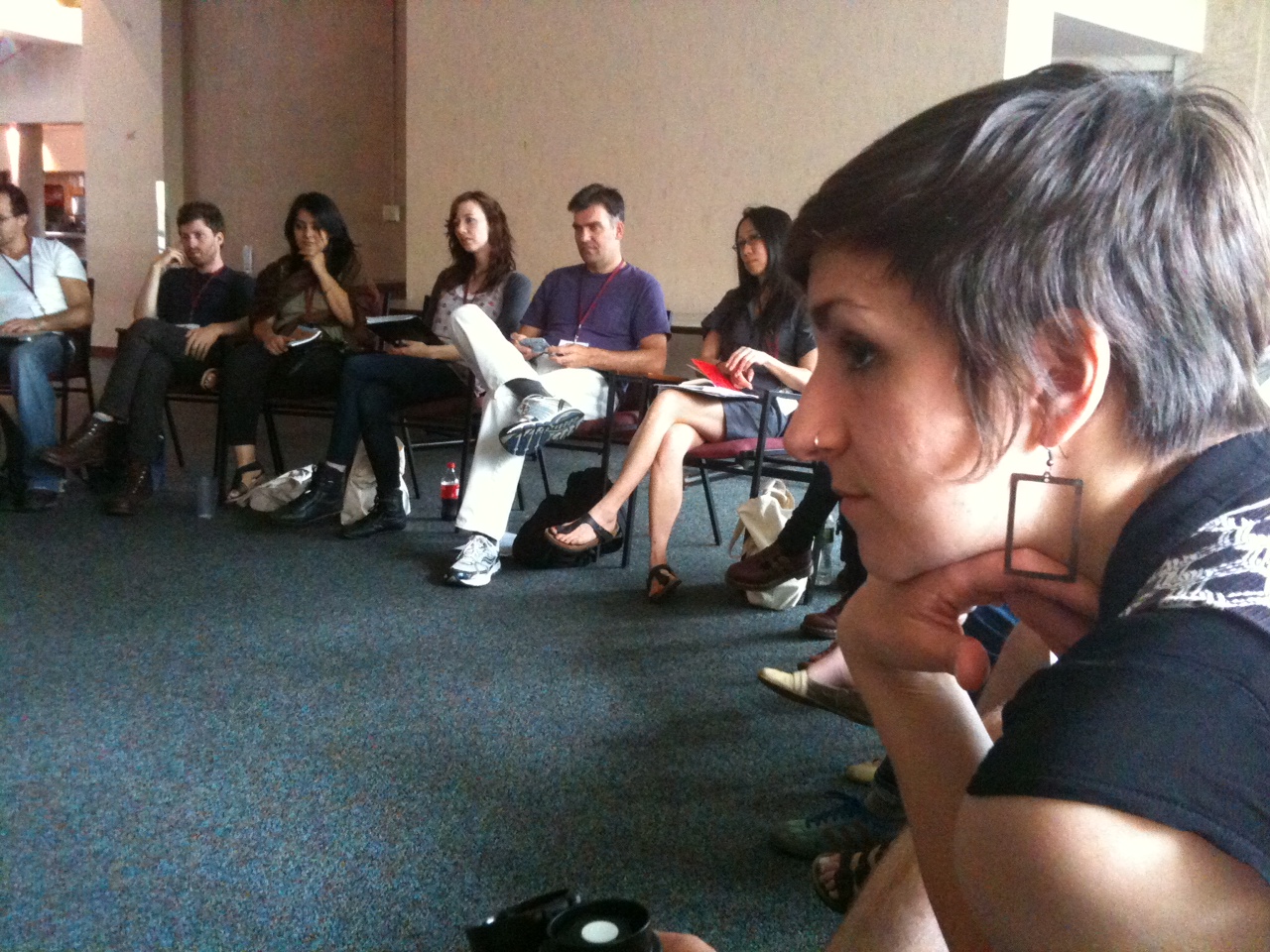
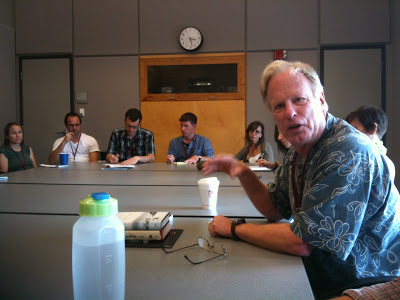
We’ve spent a lot of time in films and discussions, but I can’t say we haven’t also found some diversion – square dancing, Bill’s bar (named after Flaherty regular Bill Sloan), pickup soccer games, and a big bonfire on Monday night.As fellows we also enjoy daily lunches with the visiting filmmakers, including today with Sam Pollard.Among other topics, we discussed the distinction between conscious and sub-conscious acts of exclusion in filmmaking.
It’s been a great time so far.Some of us in the filmmaking contingent, though, are hoping that the remaining program will involve more inventive uses of sound, so that we can more deeply explore this year’s Seminar theme, Sonic Truth.There has been a preponderance of films about music, or films that contain mostly music and interview in the soundtrack.This has really limited discussion of sound recording and sound design technique.

57th Flaherty Opens
I've arrived at the 57th annual Flaherty Seminar and just finished our first round of orientations for Fellows - about 28 interesting people coming from all over the U.S. (though Brooklyn is a little over-represented!) and Latin America. As I write, the other 100+ filmmakers, critics, and programmers are arriving - and our first happy hour begins soon. I'm looking forward to watching dozens of documentary films this week... and to the legendary discussions to follow.
One of the interesting topics of discussion today was whether Robert Flaherty - canonized as the first important documentary filmmaker - really was a documentary filmmaker at all. Of course everyone knows that he staged many of his scenes, Nanook wasn't actually married to his "wife," etc. But did Flaherty even consider himself a documentarian? Scott MacDonald, who led a session for us on the history of Flaherty and The Flaherty, pointed out that he really considered himself an experimental narrative filmmaker.
These categories obviously get redefined over the years, and are not always relevant. But it reminded me of a spirited part of the Celebration of Ricky Leacock I attended at MIT last week, in which Michel Negroponte lamented that the worlds of documentary filmmakers and avant-garde art filmmakers no longer overlapped so fruitfully as they once did. That Leacock, known so well for his contributions to Direct Cinema/Cinema Vérité, was truly open and appreciative to art films. These days I often meet "artists who work in film" who harbor a real disdain for documentaries, and documentarians who have had little exposure to fine art films - even though there is real overlap in the broad range of work in both categories.
(Something else Leacock and Flaherty shared, besides a collaborative relationship and an openness to art filmmaking: a love of women! Discussions of Flaherty's "international exchanges" that produced children all over the world echoed the stories about "the many women who loved Ricky"...)
Anyway, it's with a very open mind that we as Flaherty fellows are launching into this intense experience. I was excited to see a presentation by Caroline Martel of her installation investigating the connections between industrial films and mainstream narrative films - since I've also been exploring other forms for my film work, including installation.
12th and Delaware
Docyard at the Brattle Theater showed a great film last night, 12th and Delaware, about an abortion clinic and a pro-life pregnancy care center on opposite sides of an intersection in Fort Pierce, Florida. It's a really well-crafted piece that handles a politically explosive topic with a light touch. I appreciated the way it was put together and the quiet, open approach the filmmakers (Heidi Ewing and Rachel Grady, of Jesus Camp fame) brought to their subjects.
It was also inspiring to see that a well-done musical score can really shape the aesthetic experience of an observational film without overdramatizing it (since I too often see films where I feel the music over-reaches its role).
Heidi Ewing did a Skype Q&A after the film, which she handled with intelligence and good humor despite what she called the "mad strange" feeling of talking into your digital device to an unseen audience of 100+ people.
Flaherty Fellowship
I'm really excited to be attending this year's Robert Flaherty Film Seminar as a LEF New England fellow. I haven't been to the seminar in eight years and look forward to another vision-charging experience: seven days of pure documentary film absorbtion...
Artist Talk at MassArt Thursday
Children's Opera at Boston Conservatory
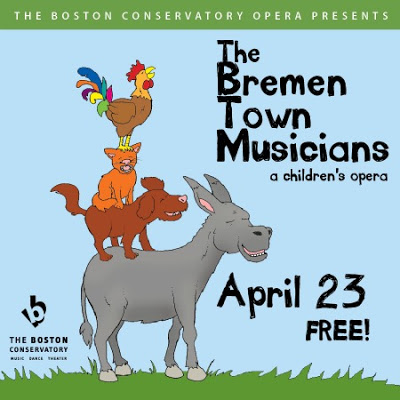
Yesterday I took my daughters to a children's opera put on by students of Boston Conservatory. This is the second one we've been to - they put on this free program twice a year - and again it was a lot of fun. The show was "The Bremen Town Musicians," a new opera by John Davies based on a Grim Brothers tale and (humorously) set to well-known music by Rossini, Offenbach, Donizetti, Verdi, and Sullivan.
The students really put their all into the performance, and director Kirsten Z. Cairns knows how to present the program to make it enjoyable to adults and children alike. Thanks for the great time!